







Application re-engineering for the change you keep putting off.
A renewal rule needs updating, but the same old module also creates invoices and feeds the reporting export. Every edit reaches further than expected. Application re-engineering services start with that dependency and the business behavior your team needs to keep.
WebXd can help define a practical scope for improving existing code, replacing a difficult component, and making the next change easier to review. The starting point is the application you already rely on.

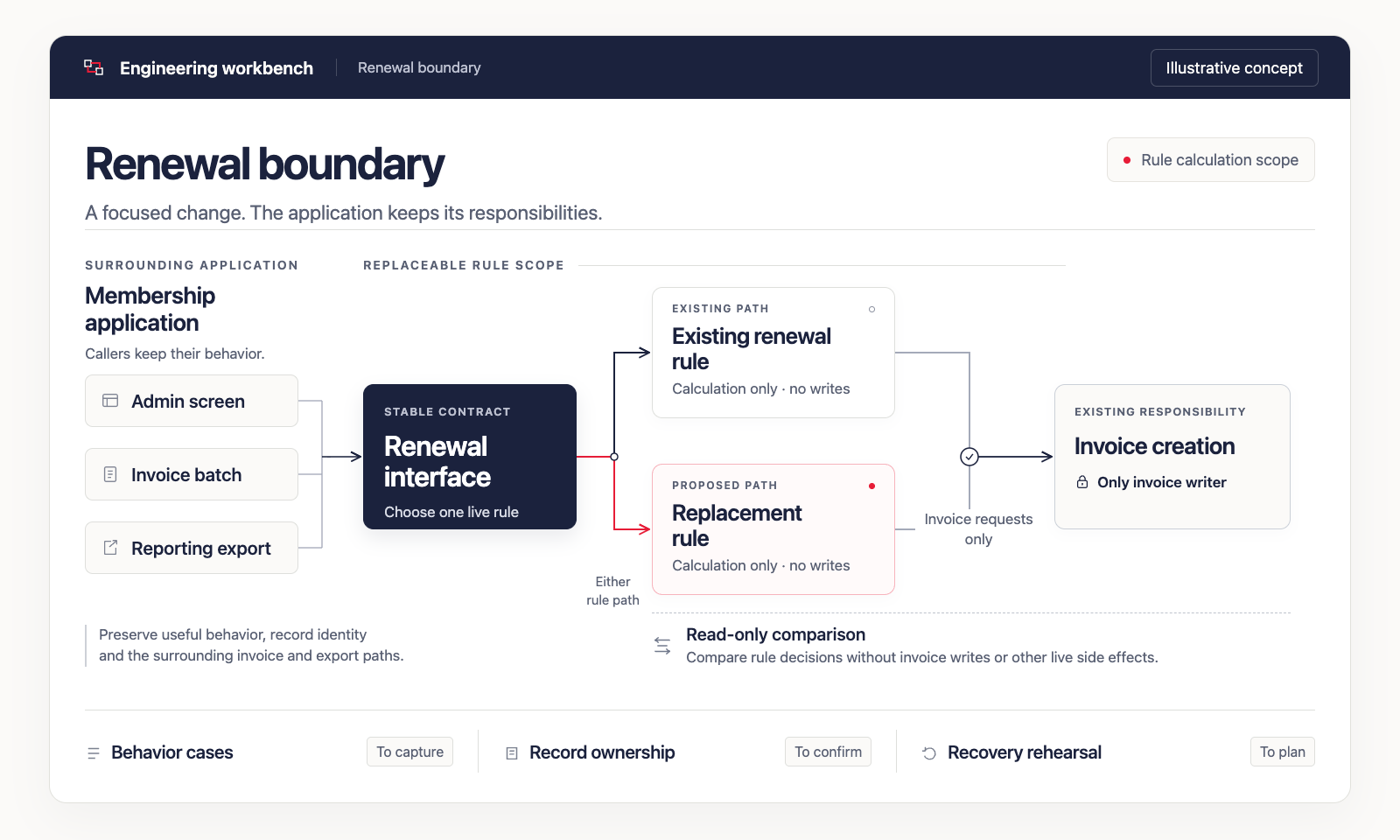
Illustrative renewal-module concept. The surrounding application keeps its responsibilities while one rule boundary becomes easier to test and change.
Trace the change that keeps spreading.
Consider a membership application whose renewal calculation lives beside invoice creation. A new renewal policy requires an edit in that shared code. The invoice batch, an administrator screen, and a monthly export all depend on the result, though each expects a slightly different format.
We would trace those callers before proposing a replacement. Which path actually changes a record? Where is a failed request retried? Your support tickets and a repeatable example help connect the code to the problem people experience. The result is a defined slice of work with its dependencies visible.
Illustrative example throughout this page; it describes a proposed approach, not a WebXd client project.
Record what the application actually does.
Old code often contains rules that never reached a specification. We can capture representative inputs and outputs, then turn important cases into repeatable regression checks. Those checks describe current behavior. Your business owner still needs to decide whether that behavior is correct.
For the renewal example, the record should include an ordinary renewal and the awkward cases that reach support. A paused account may retain its date, while a repeated request must avoid creating another invoice. An unexpected result becomes a decision to investigate, rather than something silently copied into the replacement.
| Case | Evidence to collect | Decision to record |
|---|---|---|
| Ordinary renewal | Date, invoice reference, export entry | Expected result to preserve |
| Paused membership | Current rule and support history | Confirm the pause policy |
| Repeated request | Record identity and invoice writes | Define duplicate handling |
| Failed downstream call | Saved state and retry history | Agree recovery behavior |
Choose the smallest useful intervention.
The age of the application doesn't settle the decision. If a module has useful rules and a supported foundation, restructuring it may address the problem. If an unsupported dependency blocks testing or future changes, a targeted replacement may be more useful. We compare those options against the change your business needs.
A focused assessment can end with a recommendation to keep a stable area as it is. It can also reveal that a planned feature needs a separate build. We document the reason for each choice, the temporary work it introduces, and the acceptance criteria before expanding the implementation.
Refactor in place
- Rules are valuable and recoverable
- The main problem is tangled responsibilities
- The existing runtime can remain supported
Replace a bounded slice
- A dependency obstructs the required change
- Callers can use a stable boundary
- Old and new paths can be compared
Retire or rebuild
- The workflow has lost its business purpose
- A suitable product covers the need
- Required behavior cannot fit the current design
Create a boundary around one responsibility.
A seam is a place where a dependency can be substituted or a call redirected. In this example, a renewal interface separates the rule calculation from invoice creation. That gives tests a controllable entry point and lets the surrounding application call either implementation through the same agreed contract.
The boundary may be a module inside the existing application. A separate service adds deployment and communication work, so it needs its own reason. Where selective routing is feasible, we can introduce the replacement gradually and compare its decisions using safe test data or a read-only comparison path.
Give each write one owner.
Comparing two calculations is different from letting both paths create invoices. We map which component owns each write, which identifiers survive the change, and what happens if a request arrives twice. A comparison path should avoid triggering live side effects such as sending a notice or charging an account.
When records or events move between components, the plan needs a way to detect missed and repeated work. We can define reconciliation checks and repeat-safe handling for the chosen slice. If a schema change is required, existing callers and historical records become part of its acceptance criteria.
- Name the authoritative record for each write
- Preserve or map record identifiers explicitly
- Check retries against previously completed work
- Reconcile affected records before retiring the old path
Prove the path back before releasing.
Regression coverage should follow the responsibilities touched by the change. The renewal slice needs checks at the rule boundary and at the invoice and export paths that consume it. We also agree how to observe errors in the released path and who can decide to stop the rollout.
Switching traffic back doesn't reverse data already written. The recovery plan must address records created under the new rules and whether the previous code can read them. We rehearse the agreed procedure in a suitable environment, record its limits, and keep necessary recovery material until retirement is approved.
| Recovery action | What it changes | Evidence needed |
|---|---|---|
| Return calls to the old path | Which implementation handles the next request | Old path still works with current records |
| Restore or reconcile data | Persisted state already changed by the release | Tested procedure and record of later writes |
Leave a system your team can change.
A completed slice should leave more than cleaner source files. Your team needs the behavior decisions, the checks that exercise them, and instructions for running the application. We keep the dependency choices and any remaining risks with the code so the next contributor can understand the change.
Acceptance can include a maintainer making a small follow-up edit in the test environment. Can they locate the rule, run the relevant checks, and explain how it reaches an invoice? That exercise helps reveal missing setup steps while the people who made the change are available to clarify them.
- Source changes and build/run instructions
- Behavior decisions and regression fixtures
- Data ownership and reconciliation notes
- Release, recovery, and retirement instructions
- Known limitations and named maintenance responsibilities
Questions before touching the code.
Can an application stay in use during re-engineering?
Sometimes. A bounded responsibility and a safe way to route calls can support gradual replacement while other functions remain available. Shared data or a dependency that cannot be isolated may require a planned interruption. We assess that constraint before agreeing the release approach.
What if documentation or tests are missing?
The initial scope can focus on recovering behavior evidence and establishing a repeatable environment. Source access, sample records, and people who know the everyday workflow help that work. Missing evidence becomes an explicit uncertainty in the plan, with investigation separated from implementation estimates.
How is this different from re-platforming or a new build?
Re-engineering improves the internal structure and dependencies of an existing application around useful behavior. Re-platforming changes its platform foundation. A new custom build starts from a newly defined need. One project can include several types of work, but each needs a clear scope and acceptance criteria.
What determines cost and timing?
The number of callers, data coupling, access to a working environment, and the evidence needed for release all affect the estimate. Bring a difficult change request and the stack information you have. We can use an initial assessment to define the slice and identify what still needs investigation.