






We analyzed 578 Google search results across 58 questions to find out whether pages that answer sooner rank higher. In the 40 searches with a clear, quick answer, the higher-ranked page reached the answer first just 49% of the time. That’s essentially no better than chance.
SEO advice often tells website owners to put the answer near the top of the page. The logic makes sense: give people what they’re looking for without making them scroll. But does that approach actually go along with better Google rankings?
Here at WebXd we have over 35 years of web design and SEO experience so we are always staying on top of changing trends in the industry. Our November 2026 study found no clear relationship between how quickly a page answered a question and where it ranked in Google. We did find a few other patterns worth exploring, including a possible connection between answer placement and citations in Google’s AI Overviews. It’s one test, run on one day, so treat it as a data point rather than a rule.
Key Takeaways
* Across 40 question searches, the higher-ranked page reached the answer first 49% of the time, showing no clear relationship between ranking and answer placement.
* 31% of top-10 pages never fully answered the question, including 27% of #1 results.
* On a phone, the typical answer started about 1.6 screens down, after 136 words.
* In 13 searches, pages quoted in the AI Overview tended to answer sooner than other results. It’s a lead we’re testing next.
Table of Contents
Does ranking #1 mean answering faster?
No. In our test, the #1 result got to the answer about as fast as the #10 result.
Here’s how we checked. Within each search, we took pairs of results where one reached the answer sooner. Then we asked: was the higher-ranked page the quicker one? It was 49% of the time. Think of it as a coin flip. If ranking had nothing to do with where the answer sits, the higher-ranked page would win about half the pairs, like calling heads or tails. That’s what we got. The likely range runs from 45% to 54%, so even at the generous end, ranking barely beats a guess.
In 14% of pairs, neither page was quicker, usually because neither fully answered. We left those out.
The pattern holds however you measure “quicker.” Words read before the answer came out at 50%. Time for a skimmer to find it came out at 51%.
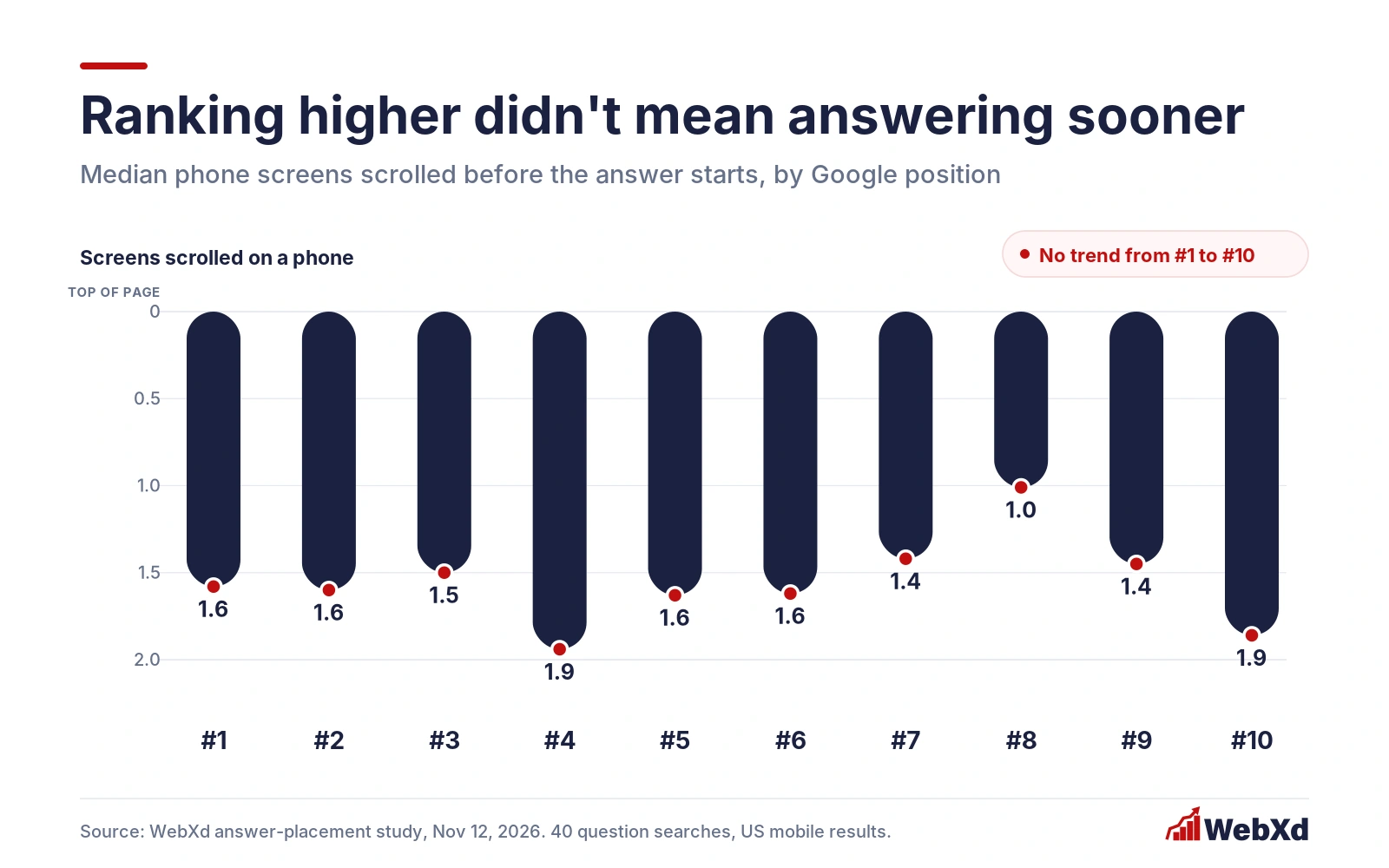
It cuts the other way too. Overall, pages that answered early didn’t rank lower. Answering first doesn’t seem to hurt; it just didn’t help here.
Did anything else we measured sort page one?
Not really. We checked nine things that could plausibly set the order, and almost all showed little difference by ranking position. That includes answer quality and site authority.
Each measure reads the same way as the headline: of page pairs that differed on it, how often did the higher-ranked page come out ahead? Seven of the nine landed between 49% and 52%. Those were scrolling to the answer, words before it, time to find it, ads before it, how directly it answers, answer quality and site authority (Ahrefs Domain Rating).
The other two were less clear. Pop-ups came out at 55%, the one possible link. Higher-ranked pages tended to cover less of the screen with pop-ups when they opened. But with nine measures checked at once, a lean this size turns up by chance fairly often, so it may be nothing. Whether a good answer appeared on the first screen came out at 45%, but too few searches had one to tell.
This doesn’t mean content quality, backlinks or authority are irrelevant to rankings. Every page here was already in the top 10, and we measured one version of each, an AI-assigned answer-quality score and Ahrefs Domain Rating, which simply showed no meaningful link to the order.
The first and last results side by side tell the same story:
| Position #1 | Position #10 | |
|---|---|---|
| Gives a full answer | 73% | 67% |
| Answer visible without scrolling | 22% | 18% |
| Where the answer typically starts | 1.6 screens down | 1.9 screens down |
| Answer quality (out of 5) | 2.9 | 2.9 |
| Median Domain Rating | 79 | 74 |
So what does rank? We can’t say from this data, but one pattern stands out. About one in five top results (22%) came from social, forum or video platforms. They took 17 of the 58 #1 spots: Reddit 12, Facebook 4 and YouTube 1. Our main result still holds with those pages removed.
What does a searcher actually get on a phone?
Often, a lot of scrolling and no answer. We opened every page fresh on a phone, the way a first-time visitor sees it, pop-ups and all. Here’s what the top results looked like:
- 136 words to read before the typical answer starts, about 22 seconds of skimming.
- 22% of pages showed the answer without any scrolling.
- 31% of pages never gave a full answer, including 27% of #1 results.
- 1 in 4 pages covered 30% or more of the screen with pop-ups or cookie walls when they opened.
The word, scrolling and full-answer figures come from the 42 quick-answer searches (379 pages). The pop-up figure covers all 570 pages that loaded.
Take the search “how much is electrician school.” None of the top five results answered it. The #6 result gave part of an answer. The first full answer came at #7, 13.6 screens and more than 1,300 words down the page. The #8 result answered on its first screen.
One search proves little either way, so don’t read this as answering early hurting rankings. It’s a picture of how far page one can be from the advice.
Some top-three pages buried the answer even deeper. The #2 result for “is cotton underwear better for women” made readers scroll 29 screens. For “how much is a bengal cat” it was 17 screens, and for “how to bet on college football” it was 12. These pages did answer eventually. They still ranked near the top.
Does answering first help you get quoted in AI Overviews?
Maybe. It’s the clearest lead in our data, but it rests on only 13 searches.
Every one of our 58 searches showed an AI Overview above the results. Not one showed a featured snippet. Much of the “answer first” advice was written with featured snippets in mind, so it’s worth retesting for a page one that looks like this. That shift matters: Ahrefs found the #1 result gets 58% fewer clicks when an AI Overview appears, which changes what a website’s traffic is worth.
Google’s own AI gives the same advice we tested. Ask it how to rank in AI Overviews, and it tells you to lead with the answer.
Google’s official guidance is more cautious. Its guide to AI search says you don’t need to write in a special way for AI systems, or break content into small chunks.
We could match the AI Overview’s cited sources to the ranking results in 13 searches. In those 13, the pages Google’s AI quoted reached the answer sooner than the other results on the same page.
The gap was about 19 percentile points, with a likely range of 5 to 32. Put simply, quoted pages sat noticeably closer to the “answers soonest” end of their search than the pages Google didn’t quote.
If answering early pays off anywhere, it may be in getting quoted, not in ranking. Thirteen searches is too few to call that a finding, so it’s the first thing we’re testing next.
What this does and doesn't tell us
It tells us answer placement didn’t track ranking in this test. It doesn’t tell us that will hold forever, or for every kind of search.
- It’s one snapshot. These are US English, mobile results from November 12, 2026. Rankings move daily, and AI Overviews are changing how page one works month to month.
- It shows association, not cause. Pages that answer early may also differ in brand, links, freshness or depth.
- It’s question searches only. We tested questions with a findable answer. Short commercial searches like “plumber near me” work differently, and this says nothing about them.
- A small effect can’t be ruled out. With 40 searches, a strong link would very likely have shown up. A weak one, a few points either side of 50%, could still be there. Pinning that down would take about 200 searches.
- Google ranks passages, not just pages. Through passage ranking, Google can find and show an answer buried deep in a page. That may be part of why placement didn’t matter here.
- Some pages couldn’t be read. We left out 58 of 578 pages, mostly video-only results (31) and login walls or empty pages (19).
- Some search types may behave differently. For “how much” searches, higher-ranked pages tended to answer later. That’s one of many groupings we checked, so it may be chance.
So should you still put the answer first?
We would, for now. Just not because you expect it to lift your rankings.
There’s a difference between making a page useful and tuning it for a ranking factor. This test only speaks to the second, and it found nothing there. The case for answering early rests on the first.
- Answer the main question clearly, near the beginning. Someone searched a question. Nearly a third of top-10 pages never fully answered it, so a page that answers quickly and completely already beats much of page one for the person reading it.
- Skip arbitrary rules. Nothing here supports a rule like “always answer within the first 50 words.” Answer as early as the question allows. Some answers need a line of context first, such as a cost that depends on where you live.
- Write for the reader, not the formula. In our test, rewriting a page just to move the answer up wouldn’t have been expected to move it up the results. The better question is whether the page answers well, not whether it follows a formula.
- Keep an eye on AI Overview citations. We saw an early association there between answering sooner and getting quoted. It’s unconfirmed, so treat it as something to watch, not a tactic. If AI search visibility matters to your business, it’s the focus of our AEO and GEO work.
- Look at your pop-ups. One in four pages opened with a pop-up or cookie wall covering at least 30% of the screen. Higher-ranked pages leaned toward fewer, though that may be chance. Either way, it’s a worse experience for readers.
- Revisit this as search changes. What holds in November 2026 may not hold in six months. We’ll be rerunning the test, and we’d suggest checking your own pages the same way.
Our take: answering first is good writing, not a ranking trick. Do it because it serves the reader, and judge your pages by whether they actually answer the question.
How we ran the study, and what's next
We repeated four steps for every search:
- Search like a customer. We pulled the top 10 Google results for 58 real question searches, in US English on a mobile phone, on November 12, 2026.
- Open every page on a phone. Each page loaded fresh on a 412×823 phone screen, the way a first-time visitor sees it, pop-ups and all.
- Find where the answer starts. An AI model, blind to the ranking and the site name, marked where each page first answers the question and how well.
- Compare with the ranking. Within each search, we checked whether higher-ranked pages got to the answer sooner, and whether they sat on stronger domains (Ahrefs Domain Rating). Then we pooled the searches.
One “screen” is what fits on that phone without scrolling. We chose the main measure, screens to the answer, before collecting any data. We report every measure we checked, not just the interesting ones.
The full report, with every search and every page, is here.
Next, we plan to rerun the test with about 200 searches and look harder at AI Overview citations. When we do, we’ll update this post at the same address.
Want to know how your own pages measure up? We can run this test on your keywords as part of our SEO services.